I wonder if we would heal as a people if we shared our stories out loud. We are so hellbent on reaching success- and in a way of maintaining our dignity and pride we focus on the good that’s happening without strong emphasis on the foundation.
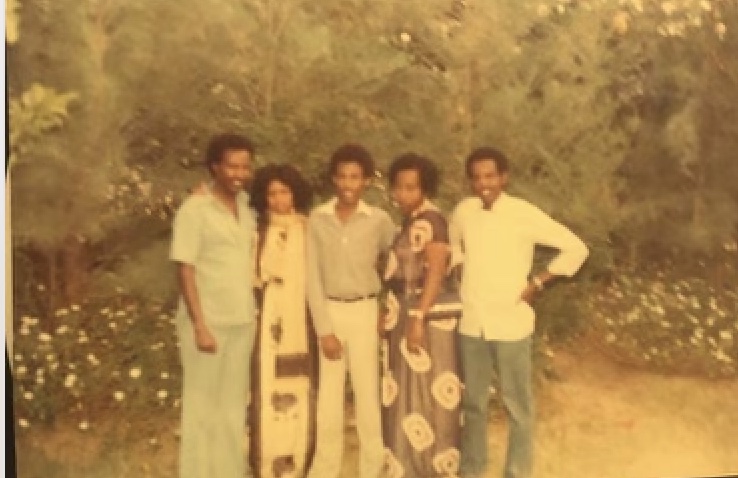
My parent’s married in 1984 in Hargeysa. My 1984 Somalia short story stems from there, it’s also the last time my mother had seen Somalia, Somali occupied lands and Africa. We have a picture of my parents in Hargeysa together (see above)- hooyo has a blown out poofy hair style (with bangs!), she’s grinning from ear to ear as they stand between their friends. Abo is also cheesing and wearing a powder blue safari suit- same color as the blue flag. They were ironically – or maybe not- in the same hotel that became my home away from home and my safe place in this city. I could not imagine these happy carefree people were my parents. They went to the Theatre in Hargeysa that trip to see “Beenay wa Run”. How do I know? Two different relatives, in different countries, on different continents told me about it when I first went to Hargeysa in 2015. To this day, its one of my favorite Somali plays.
I would have loved to see the National theatre with my own eyes and see riywayaads in live time. In Hargeysa that first summer, I was trying to soak up as much time as possible in places where people came together to celebrate art, culture, and self-expression but the city had surely changed. I also spent alot of that first trip trying to find or see any remnants of what I had read about, or heard about. Hargeysa ha Dheelin, Ha Dhantalmin Weligaaa, the city had rebuilt itself to something the people wanted it to be so Hargeysa, Hoygii Fanka and Suuganta was still super conservative and I did not hear music that much. The few spaces I did, faced heavy pushback that first year and I realized that self expression, art and culture, were still trying to find a space in a society that rejected everything that brought it pain.
I wonder what riywayaads in the country would talk about nowadays if they had access to resources and an environment to tell their stories. We are dealing with the crippling effects of climate change, bad governance and constant insecurity but life moves on. I wonder if we would heal as a people if we shared our stories out loud. We are so hellbent on reaching success- and in a way of maintaining our dignity and pride we focus on the good that’s happening without strong emphasis on the foundation. A house can be beautiful but if the foundation is not strong, it will eventually cave in on itself. After decades of being a failed state, the country and region is thriving. Life moves on, and people’s lives are built, so what would the country/ citizens share with the world?
In my mama’s podcast episode she talked about her childhood in Mogadishu, and decades later she recalled with awe and amazement as to what Mogadishu looked like during her childhood. She went from the miyi (village) to the big city, and despite living in America for decades as she told her story, she was a child transformed to that moment of seeing big buildings, the ocean and light everywhere. Suldaan Seeraar’s Iftinkii Xamar Bila lies in the city itself, forget about people. She recalled moments with her grandma and older female cousin who worked in the government. Her cousin would frequently travel and she’d bring her dresses from abroad and also take her to the National Theatre in Mogadishu. As my mom was talking, she was reliving these moments in live time, and it was like she was a child again. She was in awe of how large the theatre was, how big the curtains were and spoke on how packed it would be. Especially to commemorate key political dates and whenever there was a new play. I could never imagine living in this city at a time where you could easily have access to the ocean, the city and the grandeur of Mogadishu.
When I went to Xamar, my first night I went to Liido (the ocean). It was nighttime but the water was lukewarm and inviting. 10 PM on a July evening was still HOT in this city and I could not believe I was more covered up then I would be anywhere else in the world. I guess you need time to adjust to the city. By the ocean I ate fish and drank fruit cocktails, and the breadbasket of Somalia really lived up to its title. The assortment of various fruits and vegetables, bright and diverse, gave me a sense of something different in Somalia. That first night we also drove around all the statues and monuments. One of my dad’s childhood friends pointed out landmarks and places he had grown up in as we drove by. I asked him about where I remember my dad telling me about and he told me a bit more. I’ve learned alot about my parents through other people and being introduced to Mogadishu this way by someone new but familiar felt the same way.
I’ve traveled a lil bit but the grandiose of Mogadishu is something I was so surprised by. I did not stay too long and I appreciate the quick trip and lasting memory to stay static. I thought of my mama walking down the roads with a big afro and thin cotton dresses. She had never talked about Hargeysa before, only Mogadishu, and by being here I felt like I was witnessing a part of a life that she had. She used to live in Shangaani, and when we passed it on our way to the ocean I wondered if her old house still stood there. I recently found out her school was on a castle near the beach and I can’t believe or understand how this city that sounded like an urban paradise has become what it is now. Alot of things from childhood are sweet for some and maybe it was like that for her and peers. The city is still amazing; bringing in people by the day who are hustling for a better future, a way to make it and maybe some semblance of that old glory.

 ISIRKA
Leave a comment